What Right to Repair Means for Your Devices
September 12, 2026
What Repair Warranties Should Cover After Service
September 14, 2026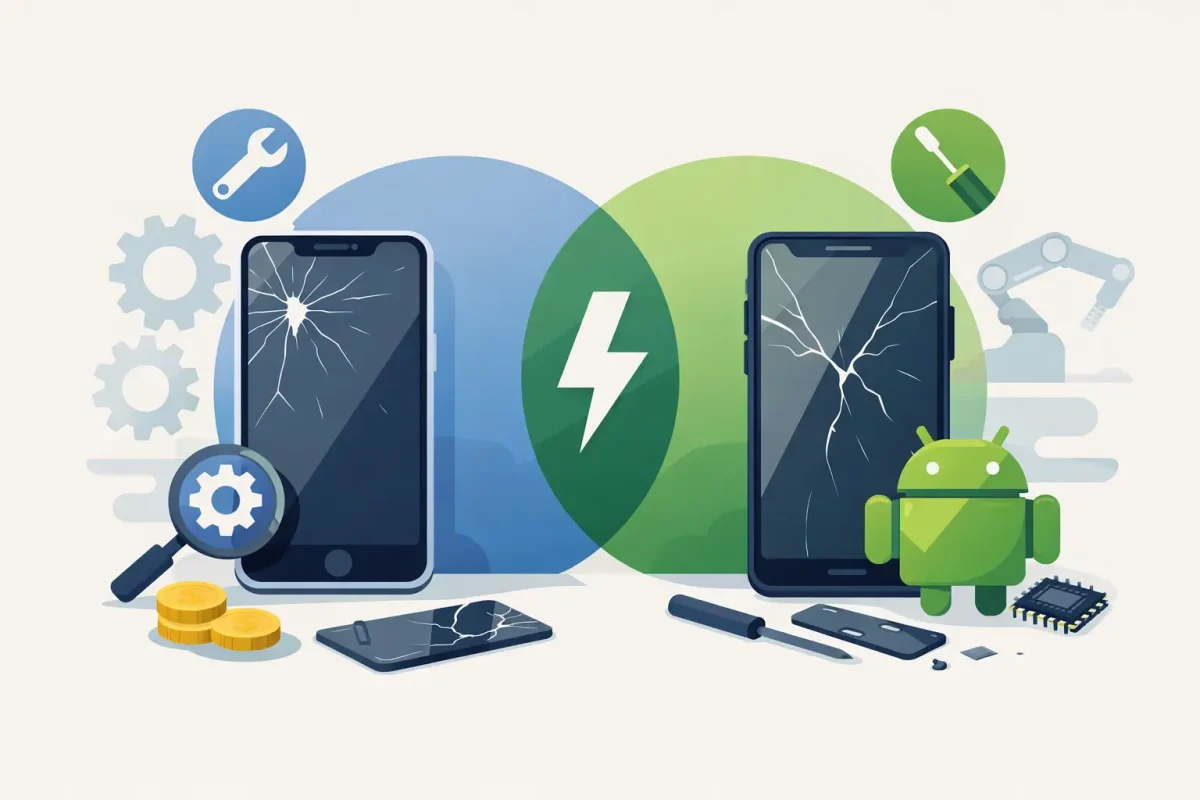
A cracked screen does not care whether the phone in your hand is an iPhone, Samsung, Google Pixel, or Motorola. But the bill to fix it can be very different. When comparing iPhone versus Android repair costs, the real question is not which platform is always cheaper. It is which specific phone is damaged, what failed, what parts it needs, and whether repairing it still makes financial sense.
For most Charlotte-area phone owners, a professional repair is far less disruptive and often far less expensive than replacing a device outright. The key is getting a clear diagnosis before assuming the repair will cost too much.
Why iPhone Versus Android Repair Costs Vary
Apple has a relatively small number of iPhone models in use compared with the many Android phones made by Samsung, Google, Motorola, OnePlus, LG, and other brands. That difference affects part availability, repair procedures, and price.
Because iPhones are so common, replacement parts for popular models are widely available. Technicians also see the same repairs often, including screen replacements, battery replacements, charging-port issues, back-glass damage, and camera problems. That consistency can make some common iPhone repairs straightforward.
Android is a larger category, not one type of phone. A budget Motorola and a flagship Samsung Galaxy may both run Android, but their repair costs can be dramatically different. A less common model may require a special-order part. A premium Android phone may use a curved OLED display, an under-display fingerprint sensor, or a complex glass back that adds labor and part cost.
In other words, comparing “iPhone” to “Android” is useful as a starting point, but model-to-model comparisons are more accurate. An iPhone Pro model may cost more to repair than a basic Android phone, while a recent Samsung Ultra can cost as much as or more than many iPhones to repair.
Screen Repairs Are Usually the Biggest Comparison
Screen damage is one of the most common reasons customers walk into a repair shop. A small crack may seem cosmetic, but it can spread, cut your finger, allow moisture inside, or cause touch problems later.
On many standard iPhones, screen replacement costs are fairly predictable because the display design and parts are widely supported. Newer iPhones with OLED displays, high refresh-rate screens, or Face ID components require more careful work and typically cost more than older LCD-based models.
Android screen repair costs have a wider range. Entry-level and midrange Android phones often use less expensive LCD screens, making replacement more affordable. Premium Samsung Galaxy, Google Pixel, and OnePlus models commonly use OLED displays. If the screen is curved or includes fingerprint sensor hardware, the repair may require a more specialized part and additional calibration.
The least expensive screen repair is not always the best value. Screen quality can affect brightness, color, touch response, battery life, and durability. A trusted repair shop should explain the part options available for your device and tell you what is included in the quoted price. Clear pricing matters, especially when a repair involves a premium display.
Glass-only damage versus display damage
If the glass is cracked but the display still looks normal and touch works, customers often ask whether only the glass can be replaced. On modern phones, the glass, touch layer, and display are usually bonded together. Replacing the full screen assembly is often the dependable repair because it restores both the visible surface and the components underneath.
If you see black spots, colored lines, flickering, ghost touches, or no image at all, the display itself is damaged. That repair will generally cost more than a simple cracked-glass issue because the full screen assembly is necessary.
Battery Replacement Is Often a Smart Value Repair
A phone that dies by lunchtime, shuts off at 20 percent, overheats during normal use, or takes forever to charge may need more than a new charging cable. Battery health declines over time on both iPhones and Android phones.
Battery replacement is often one of the best values in phone repair. It can extend the usable life of a device by a year or more, particularly if the screen, cameras, and charging system are otherwise working well. For many owners, replacing a worn battery costs much less than buying a new phone and avoids the time spent transferring data, setting up apps, and learning a new device.
iPhone battery repairs tend to be common and predictable across popular generations. Android battery pricing depends more heavily on the model. Some Android phones are designed with easier internal access, while others require removing a glued back glass, a display assembly, or several components before the battery can be reached.
A battery should be diagnosed before it is replaced. Slow charging can also come from lint in the charging port, a damaged cable, a failing wall adapter, software issues, or a worn charging port. Paying for the correct repair is better than replacing a battery that was not the problem.
Back Glass, Charging Ports, and Cameras Change the Math
Back-glass damage is common on recent iPhones and premium Android devices. The cost depends on the phone’s construction. Some models allow the rear housing or glass to be replaced more efficiently than others. On older designs, the repair may involve moving every internal component into a new housing. On newer devices, repair access may be improved, but the part itself can still be expensive.
Charging-port repairs also vary more by model than by operating system. Many Android phones use USB-C, while older iPhones use Lightning and newer models use USB-C. The connector type alone does not determine the price. What matters is whether the port is a separate component, connected to a flex cable, integrated with another assembly, or affected by liquid damage.
Camera repairs can be similarly nuanced. Replacing a single rear camera on a basic phone is very different from repairing a multi-camera flagship system with stabilization hardware, telephoto lenses, depth sensors, or front-facing biometric components. On iPhones, damage near the front camera and Face ID area deserves careful professional evaluation. On Android devices, fingerprint sensors, camera modules, and display assemblies may also need testing after repair.
Parts Availability Can Make Android Repairs Less Predictable
One advantage of popular iPhones is that parts availability is usually strong, especially for recent and widely used models. That does not mean every iPhone repair is inexpensive. Newer models, Pro devices, and repairs involving advanced features can still carry a higher price.
Android owners have more choices in devices, which is great when buying a phone but can create more variation when it needs service. Parts for Samsung Galaxy and Google Pixel models are often easier to source than parts for a rare, older, carrier-specific, or discontinued Android phone. If a part must be ordered, the repair may take longer and the final price can be less predictable.
A good repair shop will not guess. Certified technicians should identify the exact model, inspect the damage, verify part availability, and provide the repair price before work begins. That protects you from hidden fees and helps you decide whether to repair, replace, or consider a refurbished device.
When Repair Is Worth It
Repair is usually the right move when the phone is paid off, works well outside of the damaged component, and would cost much more to replace than to fix. A screen, battery, port, or camera repair can keep a dependable device in service without adding another monthly payment.
Replacement may make more sense when a phone has several expensive failures at once, has severe liquid corrosion, no longer receives security updates, or needs a repair close to its resale value. The decision is especially personal for older budget Android phones, where a major screen replacement may approach the cost of a comparable replacement device.
Before making the call, consider the phone’s condition beyond the visible damage. Does it hold a signal? Are the cameras working? Is the storage sufficient? Does it still run the apps you need for work, school, banking, and family communication? If the answer is yes, a targeted repair may be the most affordable path.
Get a Clear Quote Before You Replace Your Phone
The fastest way to compare iPhone versus Android repair costs is to bring in the device for a professional diagnosis. A technician can check whether a cracked screen also damaged the display, whether a phone that will not charge has a bad port or packed-in debris, and whether water damage is limited or spreading.
At Device Doctor, customers can get straightforward help for iPhones and a wide range of Android devices without being pushed into a replacement they do not need. Ask for a quote, ask what part is being used, and ask how long the repair should take. Those answers make the cost comparison useful.
Your phone is more than a piece of glass and metal. It holds your photos, directions, work messages, school accounts, and everyday connections. If it is cracked, dead, or refusing to charge, getting the right repair may be the simplest way to get your day back on track.